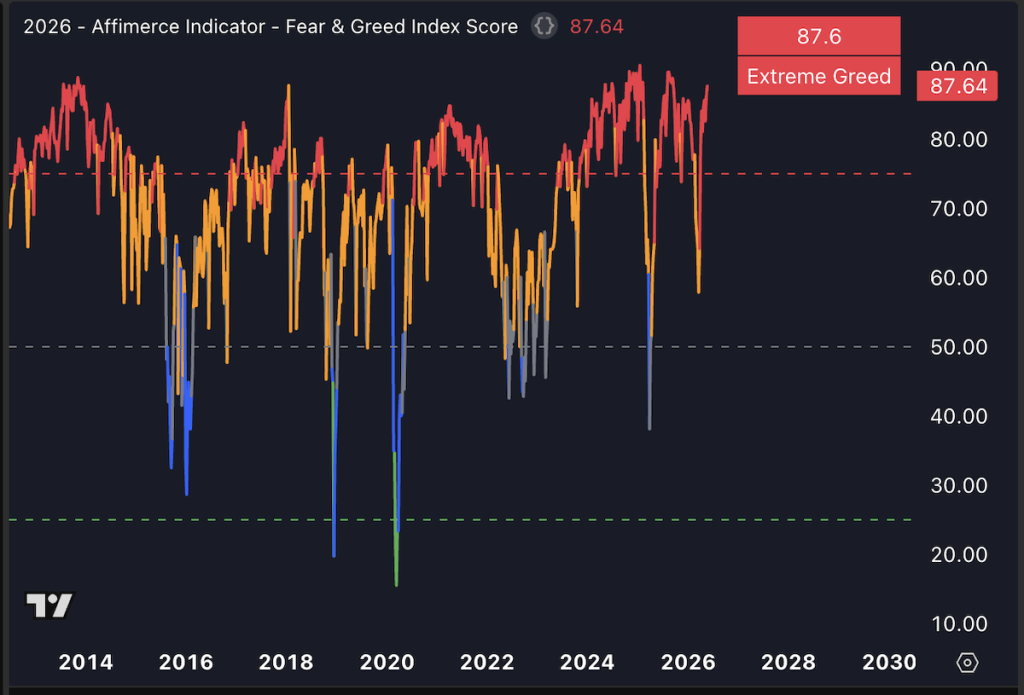
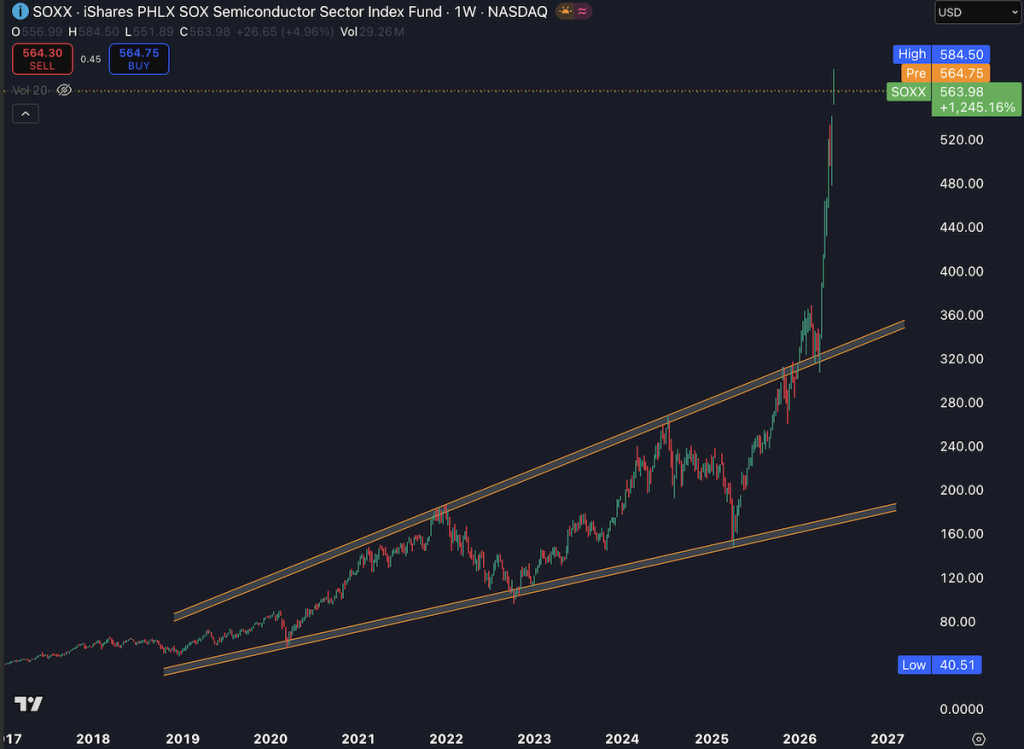
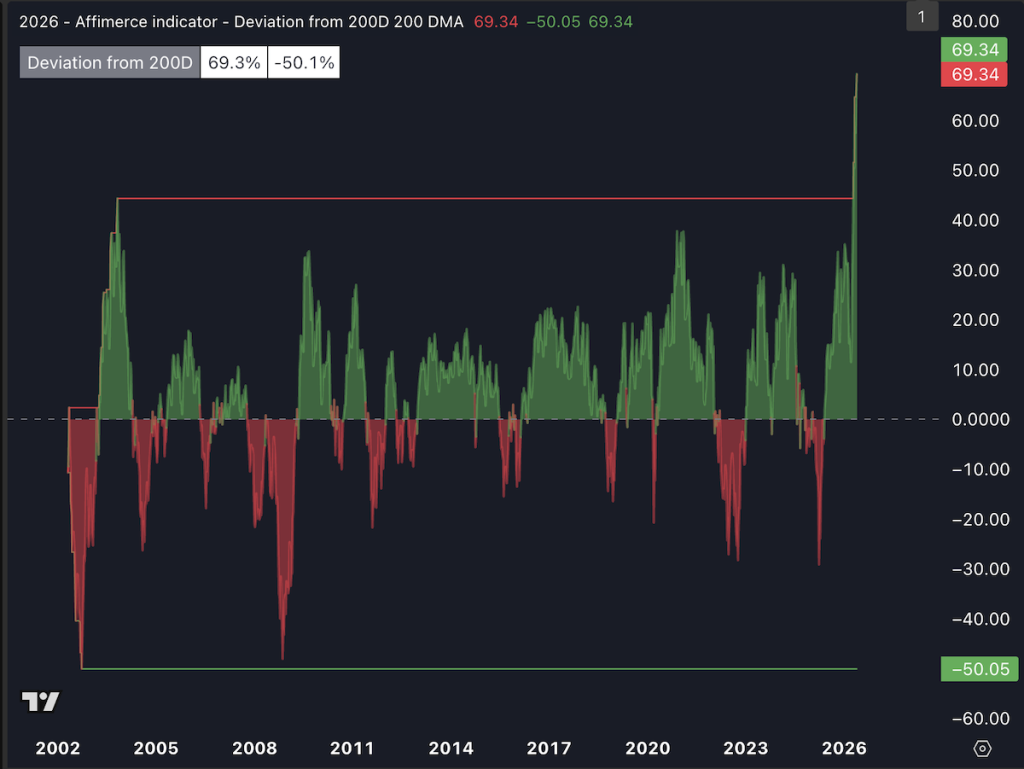
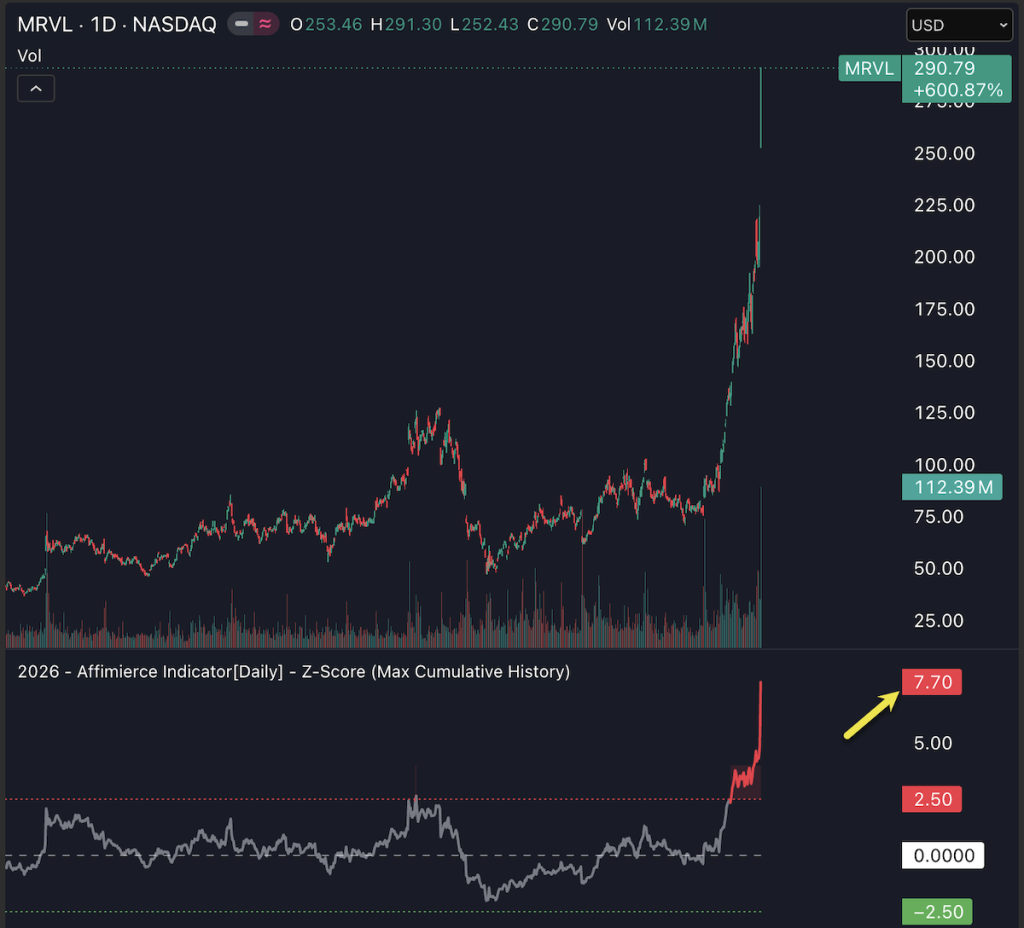
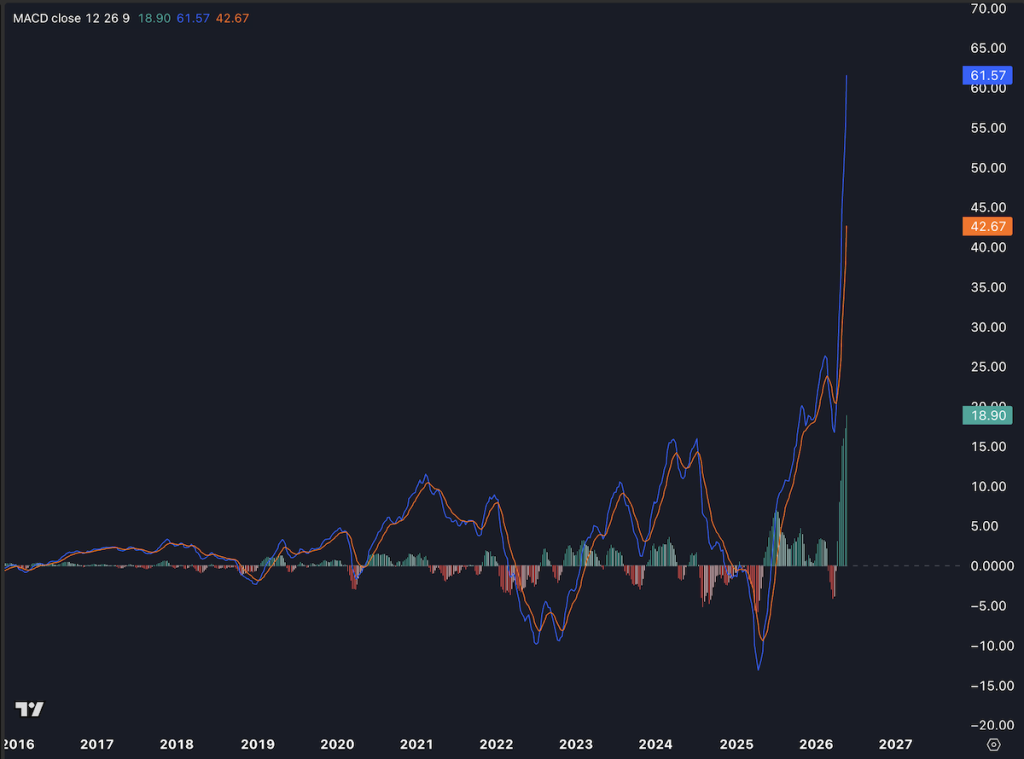
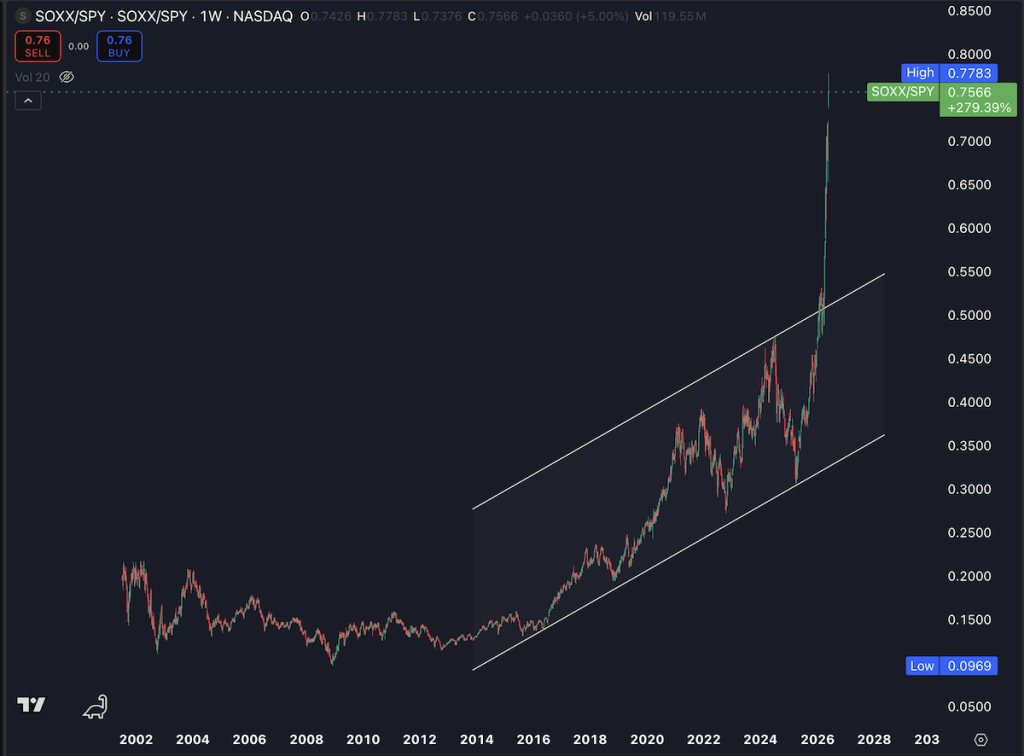
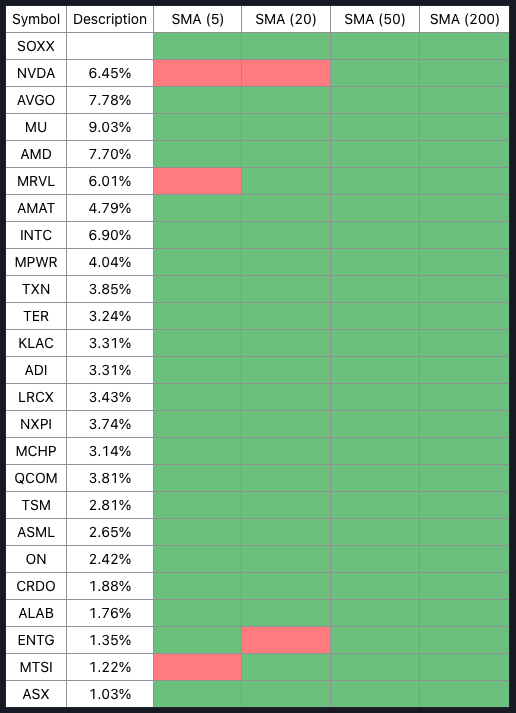
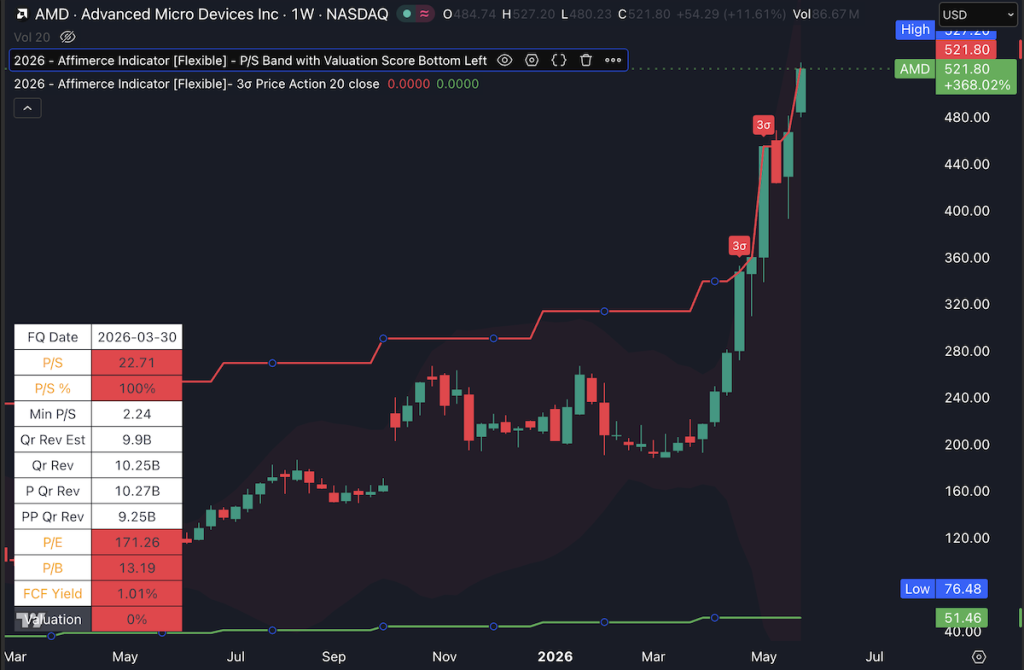
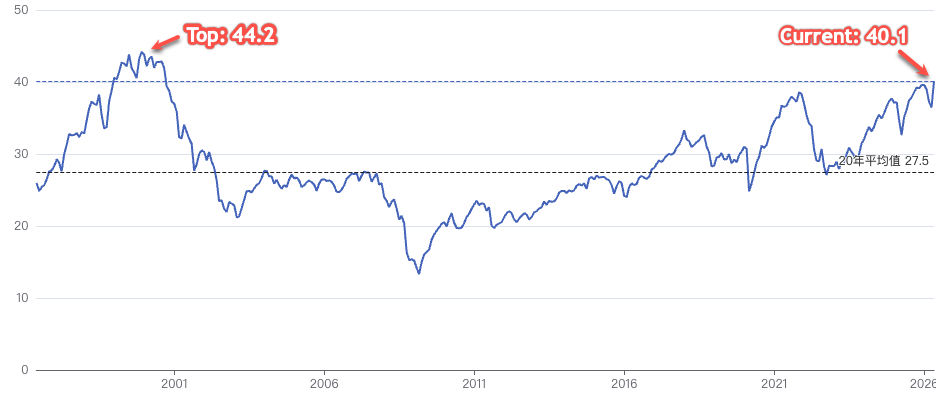
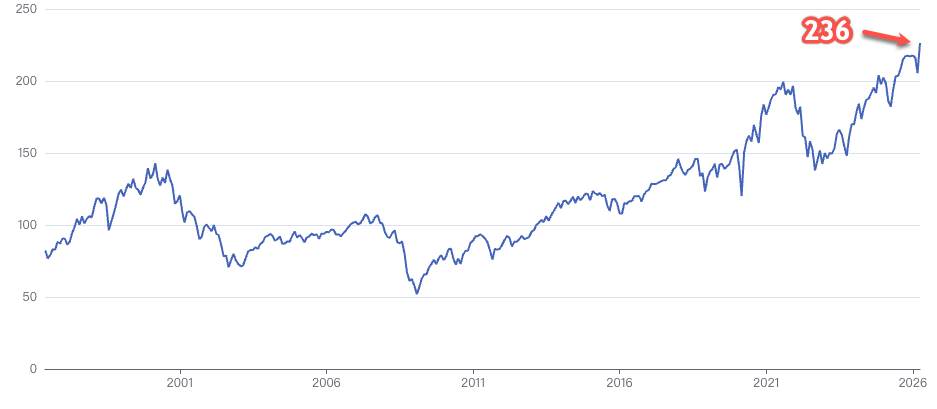
It is starting to feel like value investors are giving up. For many of them, traditional valuation discipline feels like it has stopped working.
The setup feels uncomfortably similar to late 2000, a narrow group of market leaders, a powerful growth story, and a long list of profitable companies being ignored because they are not part of the dominant narrative.
When Julian Robertson shut down Tiger Management in March 2000, he left value investors with a message that still feels relevant. “The key to Tiger’s success over the years has been a steady commitment to buying the best stocks and shorting the worst,” he wrote.
“In a rational environment, this strategy works well. But in an irrational market, where earnings and price considerations take a back seat to mouse clicks and momentum, such logic, as we have learned, does not count for much.”
- Market concentration is extreme, but that does not mean every non-AI stock is attractive.
- The best opportunities are likely in companies with strong cash flow, durable margins, and discounted valuations.
- Affimerce scores help compare quality, growth, profitability, and valuation in one framework.
- Value investing works best when patience is paired with evidence, not just low prices.
The Market Is More Concentrated Than Ever
The stock market may appear healthy on the surface, but beneath the headlines, capital has become concentrated in a way rarely seen in modern history.
For more context on how stretched the semiconductor trade has become, see “Understanding Market Extremes in 2026.”
Let’s look at the top ten holdings of the S&P 500 as of 09/2000 and 06/2026.
| Top 10 Holdings (09/2000) | Weight % | Top 10 Holdings (06/2026) | Weight % | |
|---|---|---|---|---|
| 1 | General Electric Co. (GE) | 4.53% | NVIDIA Corp. (NVDA) | 7.81% |
| 2 | Cisco Systems, Inc. (CSCO) | 3.11% | Apple Inc. (AAPL) | 6.81% |
| 3 | Microsoft Corp. (MSFT) | 2.51% | Microsoft Corp. (MSFT) | 4.53% |
| 4 | Exxon Mobil Corp. (XOM) | 2.46% | Amazon.com, Inc. (AMZN) | 3.73% |
| 5 | Pfizer, Inc. (PFE) | 2.25% | Alphabet Inc. Class A (GOOGL) | 3.39% |
| 6 | Intel Corp. (INTC) | 2.21% | Broadcom Inc. (AVGO) | 2.77% |
| 7 | Citigroup, Inc. (C) | 1.93% | Alphabet Inc. Class C (GOOG) | 2.72% |
| 8 | Oracle Corp. (ORCL) | 1.76% | Meta Platforms, Inc. (META) | 2.03% |
| 9 | American International Group (AIG) | 1.76% | Micron Technology, Inc. (MU) | 1.78% |
| 10 | EMC Corp. (now Dell) | 1.71% | Tesla, Inc. (TSLA) | 1.71% |
| Total | 24.23% | 37.28% |
As of mid-2026, the ten largest companies in the S&P 500 account for roughly 37% of the index’s total market capitalization, based on the table above.
Just a handful of mega-cap technology and semiconductor stocks, including Nvidia, Broadcom, Micron, Apple, Amazon, Meta, and Alphabet, have driven a disproportionate share of the market’s gains over the past two years.
Much of that concentration has been fueled by the AI boom.
Investors have poured capital into companies perceived to be the primary beneficiaries of artificial intelligence.
- Nvidia alone has added several trillion dollars in market value since the launch of ChatGPT in late 2022.
- Semiconductor ETFs and AI-related funds have attracted massive inflows.
Meanwhile, many businesses outside the AI narrative have been pushed aside.
One way to see this is through the SPY/RSP ratio, which compares the market-cap-weighted S&P 500 ETF with the equal-weight S&P 500 ETF.
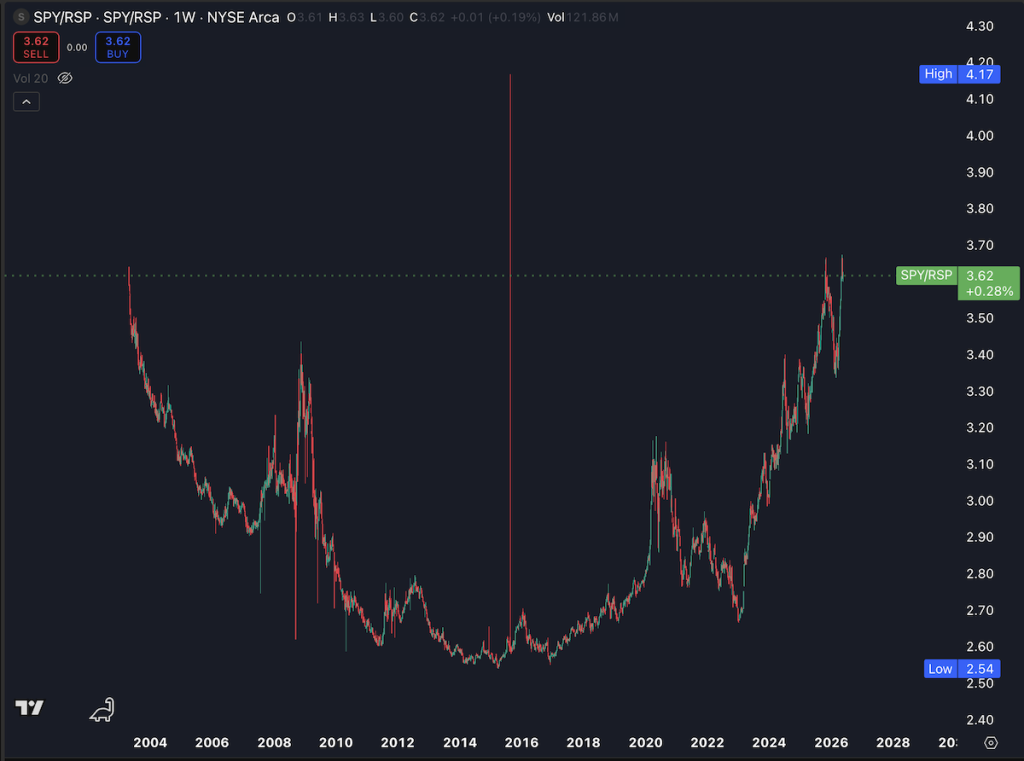
When the ratio rises, it usually means the largest companies are outperforming the average stock.
History suggests that such periods of concentration often create opportunities elsewhere.
- In the late 1990s, investors crowded into internet stocks while many profitable industrial and financial companies traded at depressed valuations.
- During the Nifty Fifty era of the early 1970s, investors paid extraordinary multiples for a small group of perceived “can’t-miss” businesses.
In both cases, the underlying innovations were real, but the market eventually rediscovered value beyond the dominant narrative.
Today, a similar disconnect appears to be emerging.
While AI-related companies command premium valuations, many high-quality businesses trade at some of the lowest multiples seen in years.
Companies such as Adobe, PayPal, Lululemon, Accenture, and Veeva continue to generate meaningful free cash flow, maintain strong competitive positions, and earn attractive returns on capital.
For value investors, that may be where the real opportunity lies.
What Makes a Great Business?
A stock can be cheap because the market is wrong. It can also be cheap because the business is deteriorating.
Distinguishing between the two is where investing becomes difficult.
A great business often shows some combination of the following traits:
- Strong balance sheet
- ROIC > 15%
- Operating Margin > 20%
- Net Debt / EBITDA < 2x
- Consistent free cash flow
- Double-digit revenue growth
The numbers make the disconnect easier to see.
| Metric | ADBE | LULU | PYPL | VEEV | ACN |
|---|---|---|---|---|---|
| Net Debt / EBITDA | 0.1 | 0.8 | 0.3 | -6.9 | -0.1 |
| ROIC | 42% | 23.7% | 16.2% | 13.8% | 20.3% |
| Operating Margin | 35% | 11.6% | 19.6% | 31% | 13.5% |
| FCF Margin TTM | 41% | 11.4% | 16.2% | 49% | 17.3% |
| Revenue YoY | 13% | 4.26% | 8.8% | 16.3% | 8.3% |
| Adjusted P/E | 11.1 | 9.1 | 8 | 27 | 10.6 |
We use four Affimerce indicators to monitor the key metrics:
- Financial Engine (Quality of the Business): It measures a company’s overall financial strength by combining profitability, growth, balance sheet quality, and cash generation into one easy-to-read score.
- Profitability Engine (Economic Moat): It helps investors identify businesses with superior margins, returns on capital, and durable earnings power.
- Growth Engine (Future Potential): It tracks whether a company is still expanding revenue, earnings, and free cash flow at an attractive pace.
- Valuation Engine (Margin of Safety): It shows whether a stock looks cheap or expensive relative to its own fundamentals and historical valuation range.
The four Affimerce indicators score each company on a 0–100 scale. Higher scores indicate stronger fundamentals, better profitability, healthier growth, or more attractive valuation, depending on the indicator.
The Affimerce Opportunity Score combines financial strength, profitability, growth, and valuation into a single 0–100 rating.
- Companies scoring above 80 are typically strong candidates because they combine solid fundamentals with attractive valuations.
- Companies scoring below 60 are usually weaker candidates, either because business quality is lower or valuation already reflects too much optimism.
To make the framework more concrete, let’s use Adobe as an example.
The four Affimerce engines break the company into financial strength, profitability, growth, and valuation, so investors can see whether the stock is cheap for a good reason or simply being overlooked.
1. Financial Engine: Balance Sheet and Cash Flow
2. Profitability Engine: Margins and Returns
3. Growth Engine: Revenue and Earnings Momentum
4. Valuation Engine: Margin of Safety
Adobe is not perfect. Its growth score is weaker than its profitability and valuation scores. But that is exactly what makes the setup interesting.
The market is pricing Adobe as if AI will permanently impair the business, while the company still shows exceptional profitability, strong cash generation, and a valuation that already reflects a large amount of pessimism.
Note: Affimerce scores and adjusted valuation metrics are calculated using Affimerce’s proprietary indicator framework as of 6/18/2026. Scores are intended for research and comparison purposes, not as standalone investment recommendations.
| Company | Financial Engine | Profitability Engine | Growth Engine | Valuation Engine | Affimerce Opportunity Score |
|---|---|---|---|---|---|
| Adobe | 80 | 100 | 59 | 92 | 87 |
| Lululemon | 95 | 75 | 20 | 90 | 82 |
| PayPal | 83 | 62 | 46 | 100 | 83 |
| Veeva | 97 | 87 | 63 | 70 | 78 |
| ACN | 94 | 69 | 62 | 90 | 85 |
| Zoetis | 70 | 100 | 56 | 73 | 75 |
| Intuit | 90 | 87 | 57 | 83 | 83 |
| PDD | 90 | 65 | 54 | 90 | 82 |
| Duolingo | 93 | 78 | 88 | 76 | 82 |
| FactSet | 72 | 87 | 36 | 87 | 78 |
| UiPath | 96 | 58 | 83 | 79 | 81 |
By comparison, here are several mega-cap technology and semiconductor companies:
| Company | Financial Engine | Profitability Engine | Growth Engine | Valuation Engine | Affimerce Opportunity Score |
|---|---|---|---|---|---|
| MU | 90 | 89 | 94 | 39 | 59 |
| MRVL | 74 | 45 | 71 | 15 | 31 |
| AMD | 96 | 43 | 94 | 30 | 49 |
| AVGO | 80 | 100 | 94 | 23 | 45 |
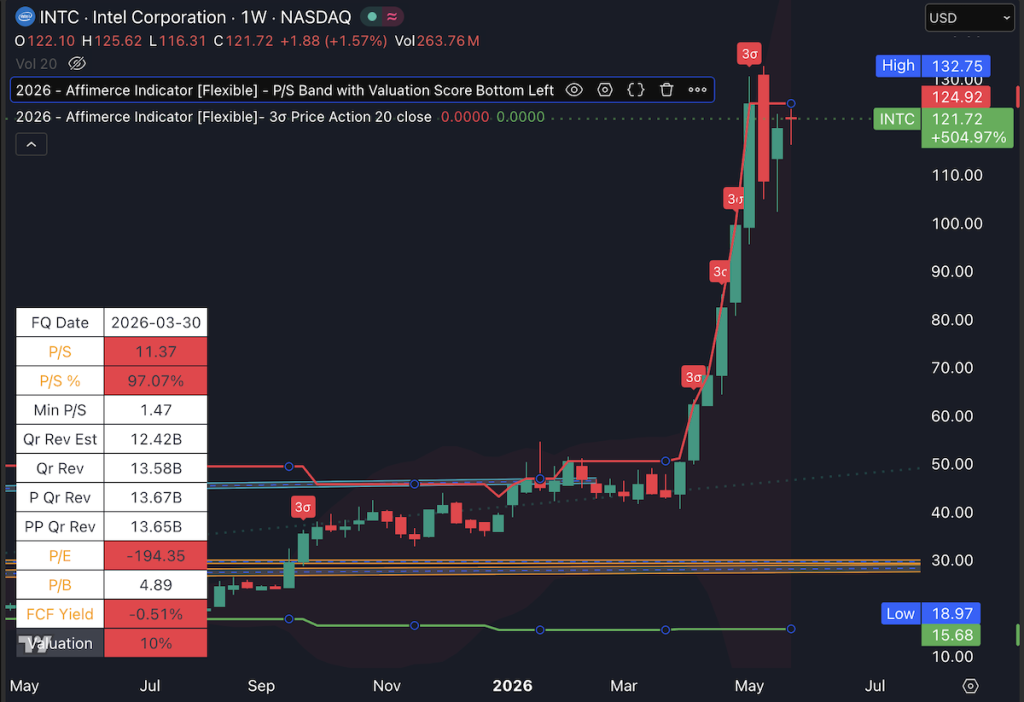
| INTC | 60 | 5 | 49 | 0 | 0 |
| Texas Instruments | 74 | 87 | 76 | 4 | 18 |
| NVDA | 90 | 100 | 97 | 54 | 71 |
| Tesla | 89 | 6 | 65 | 11 | 26 |
| Apple | 81 | 94 | 86 | 27 | 48 |
| Meta | 86 | 100 | 84 | 51 | 68 |
| Amazon | 58 | 55 | 80 | 57 | 59 |
| 90 | 94 | 87 | 41 | 61 | |
| Microsoft | 81 | 100 | 73 | 54 | 68 |
Within this group, Nvidia, Meta, Google, and Microsoft score higher than most other AI leaders on the Affimerce framework.
From a fundamental perspective, it’s very difficult to understand why investors are chasing INTC. It may be the top short candidate on our list.
That said, shorting stocks in a manic market environment can be extremely dangerous.
Still, the table shows a clear tension: many of these businesses are excellent, but their valuations already assume a great deal of future success.
Why Are These Stocks So Cheap?
None of these characteristics guarantees investment success.
Still, when a company earns a high opportunity score, it often means the business quality is stronger than the valuation suggests.
That gap between business quality and market perception is where value investors should focus.
Let’s look at a few of these companies and the narratives that have pushed their valuations lower.
| Company | Quality | Valuation | Market Narrative |
|---|---|---|---|
| ADBE | High | Cheap | AI disruption |
| Lululemon | High | Cheap | Management uncertainty |
| PayPal | High | Cheap | Fintech commoditization |
| VEEV | High | Moderate | Growth deceleration |
| ACN | High | Cheap | AI disruption |
Adobe
Adobe is perhaps the clearest example of a great business trapped inside a negative narrative.
The stock is cheap because the market believes AI will commoditize content creation and weaken Adobe’s competitive advantage.
Investors fear that tools like ChatGPT, Midjourney, and Gemini will reduce demand for Photoshop and Creative Cloud.
Yet Adobe continues to generate over $8 billion in annual free cash flow, maintains operating margins near 35%, and remains deeply embedded in professional creative workflows.
Lululemon
For Lululemon, the issue is not current profitability. It is investor confidence in the brand’s next stage of growth.
Investors worry that growth is slowing, competition is intensifying, and recent management changes signal deeper challenges for the brand.
Even so, Lululemon continues to generate exceptional returns on capital, industry-leading margins, and strong free cash flow.
The key question for Lululemon is not whether the brand is broken. It is whether the market is overreacting to a normal period of slower growth after years of exceptional execution.
PayPal
PayPal’s problem is not profitability. The problem is perception.
Investors fear that competition from Apple Pay, Stripe, Block, and countless fintech startups will permanently erode its relevance.
Yet PayPal still serves hundreds of millions of active accounts, generates billions in annual free cash flow, and remains deeply embedded in global digital commerce.
The stock trades at a valuation typically reserved for declining businesses, despite continued profitability and cash generation.
PayPal no longer receives the valuation of a high-growth fintech company, but it still has the scale, customer base, and cash flow profile of a durable payments franchise.
Veeva
The company dominates life-sciences software, serves most of the world’s largest pharmaceutical companies, carries no debt, and maintains gross margins around 70%.
Veeva is not as cheap as some of the others, but its valuation has compressed because investors believe its fastest growth years are behind it.
Yet Veeva remains the dominant software platform for the life sciences industry, maintains a debt-free balance sheet, and generates some of the highest margins in enterprise software.
The market is focusing on slower growth, while overlooking the durability of Veeva’s competitive position.
Veeva’s valuation depends less on explosive growth and more on durability. If the company can continue compounding at a steady rate, the current multiple may prove too pessimistic.
Accenture
Accenture is being discounted for a different reason: investors fear AI will disrupt traditional consulting and IT services.
Investors worry that AI tools will reduce demand for large consulting engagements and pressure future growth.
Yet Accenture remains one of the world’s largest technology consulting firms, generates substantial free cash flow, and continues to help enterprises implement the very AI technologies investors fear will replace it.
The stock is priced for disruption, while the business continues to benefit from digital transformation spending.
The irony is that AI may not simply disrupt Accenture’s business. It may also create a new wave of consulting demand as large enterprises need help implementing, integrating, and governing AI systems.
What History Teaches Us
Markets have a tendency to extrapolate recent trends far into the future.
When a small group of stocks dominates returns, investors often begin to believe that those winners deserve increasingly higher valuations, while companies outside the spotlight deserve increasingly lower ones.
History suggests otherwise.
In the early 1970s, investors became obsessed with the so-called “Nifty Fifty,” a group of dominant growth companies including Coca-Cola, McDonald’s, Polaroid, and Xerox.
These businesses were viewed as so exceptional that valuation supposedly no longer mattered. Many traded at price-to-earnings ratios above 40x, 50x, or even 80x earnings.
The companies themselves were often excellent. The problem was the price investors were willing to pay.
When market conditions changed, many of these stocks lost 50% to 80% of their value despite continuing to grow their businesses.
A similar pattern emerged during the dot-com bubble.
By March 2000, technology stocks represented more than 30% of the S&P 500, while many traditional businesses traded at single-digit earnings multiples.
Investors poured capital into companies with little or no profit because the promise of future growth seemed irresistible.
Julian Robertson’s Tiger Management became one of the most famous casualties of that period.
Robertson was criticized for refusing to chase internet stocks and for maintaining positions in out-of-favor value businesses.
After years of underperformance, he closed the fund in March 2000, arguing that the market had become detached from economic reality.
Ironically, the Nasdaq peaked only days later. Over the next two years, the index fell nearly 78%.
The lesson is not that every market concentration ends in a crash.
The lesson is that extreme valuation gaps rarely persist forever.
Eventually, expectations and reality converge.
History does not repeat exactly, but it often rhymes.
Investors who purchased quality businesses at depressed valuations during previous periods of market concentration were often rewarded once sentiment normalized.
The challenge is that these opportunities rarely feel comfortable in real time.
The best opportunities usually do not arrive with universal agreement. They tend to appear when market attention becomes so narrow that strong businesses are left behind.
The Opportunity Hidden in Plain Sight
The most attractive investment opportunities are rarely found in companies that everyone is talking about.
They are often found in businesses that continue to execute at a high level while investors focus their attention elsewhere.
That appears to be the case today.
While headlines are dominated by artificial intelligence, semiconductors, and a handful of mega-cap technology stocks, many exceptional businesses are trading at valuations that imply years of mediocre performance ahead.
Yet the underlying fundamentals tell a very different story.
Consider the characteristics shared by many of these companies:
- Strong balance sheets with little or no debt
- Consistent free cash flow generation
- Returns on invested capital are well above the market average
- Durable competitive advantages
- Long histories of profitable growth
- Recurring revenue models
- Management teams with disciplined capital allocation records
Historically, businesses with these traits have commanded premium valuations.
Today, many do not.
Adobe trades at valuation levels that reflect deep skepticism, despite generating billions in annual free cash flow and maintaining operating margins near 35%.
Even outside software, numerous high-quality businesses in healthcare, financial services, consumer brands, and industrial technology trade at discounts to their historical valuation ranges despite maintaining strong competitive positions.
History shows that some of the best investments emerge from precisely this setup.
Investors often assume that great businesses must always trade at high prices. In reality, periods of market concentration can create temporary disconnects between business quality and stock prices.
Eventually, those gaps close.
- Sometimes it happens through earnings growth.
- Sometimes it happens through multiple expansion.
- Sometimes both occur simultaneously.
A company trading at 10–12x earnings that continues compounding profits at high-single-digit or low-double-digit rates does not require heroic assumptions to produce attractive long-term returns.
That is the essence of the opportunity.
The goal is not to predict when market leadership will change.
The goal is to identify exceptional businesses that are already priced as if their future is ordinary.
When quality can be purchased at a discount, patience often becomes the most valuable asset an investor can own.
Conclusion
Today, investors are paying elevated valuations for companies perceived to be AI winners while simultaneously assigning unusually low valuations to businesses with exceptional economics, strong balance sheets, and durable competitive advantages.
History suggests that such valuation gaps rarely persist forever.
The opportunity is not in predicting when the market rotates. It is in owning quality before the market remembers it exists.